On this page
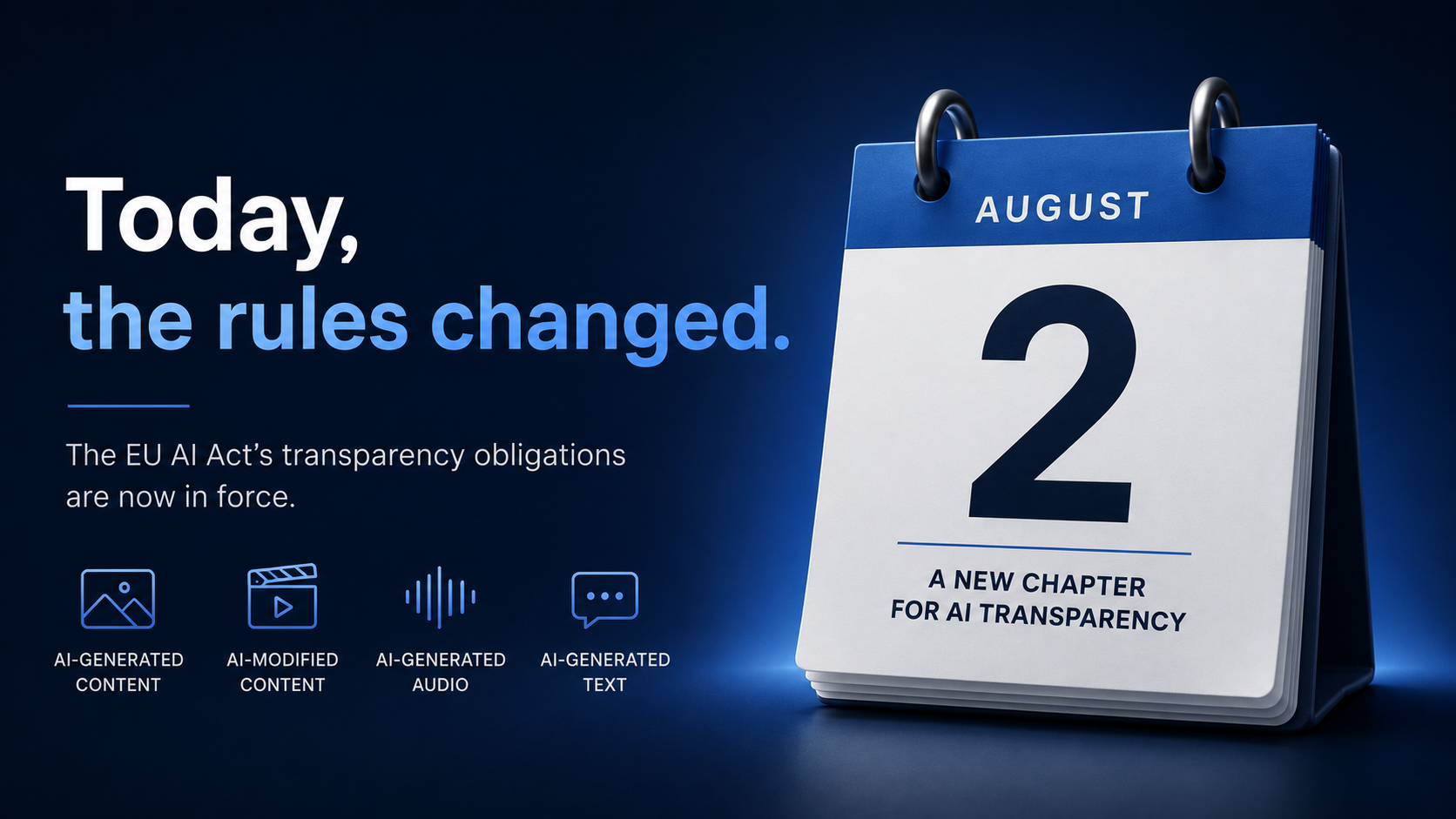
Today marks an important milestone for AI regulation in Europe.
As of 2 August 2026, the transparency obligations under Article 50 of the EU AI Act are now in force. For many organisations, these are the first AI Act requirements that directly affect how AI-generated content is presented to customers.
If your business uses AI-generated images, video, audio, chatbots or certain AI-generated text, now is the time to understand what has changed.
What came into force today?
Article 50 introduces transparency obligations designed to ensure people know when they are interacting with AI or viewing certain AI-generated or AI-manipulated content.
Depending on how AI is used, organisations may now need to:
- Inform users when they are interacting with an AI system, such as a chatbot.
- Clearly disclose qualifying AI-generated or AI-manipulated content, including certain deepfakes.
- Disclose certain AI-generated text published on matters of public interest where there has been no meaningful human editorial review.
- Meet additional transparency obligations for certain emotion recognition and biometric categorisation systems.
Does this only apply to EU companies?
No.
The EU AI Act has an extraterritorial scope. Organisations based outside the EU may still be subject to these obligations if they place AI systems on the EU market or if AI-generated outputs are made available to people in the EU.
If you sell products or services into Europe, the AI Act may still apply to you.
Does every AI-generated image now need a label?
Not necessarily.
The European Commission's guidance makes it clear that disclosure requirements depend on how AI has been used and the purpose of the content. There are important exceptions and the analysis is often more nuanced than simply asking whether AI was involved.
Businesses should assess AI-generated and AI-modified content against the Article 50 guidance before deciding whether disclosure is required.
What should businesses do now?
Now that the transparency obligations are in force, organisations should:
- Audit where AI is used across websites, marketing and customer communications.
- Identify content that may require disclosure.
- Implement appropriate AI disclosure labels where required.
- Keep records of compliance decisions.
- Monitor future guidance and enforcement activity across EU Member States.
What happens next?
Although today's deadline is significant, it is unlikely that every organisation will become compliant overnight.
Many businesses are still assessing the guidance, updating internal processes and deciding how best to implement disclosures. Enforcement approaches are also expected to evolve as regulators begin applying the new rules in practice.
What has changed, however, is simple:
The transparency obligations under Article 50 are no longer something businesses need to prepare for—they are now law.
FAQ
Does the EU AI Act apply to companies outside the EU?
Do all AI-generated images need a disclosure?
When did the Article 50 transparency obligations come into force?
How can I check if my website needs AI disclosures?
Further reading
See where your site stands
Run a free scan to find AI-generated images, video, and text on your site that may need an Article 50 disclosure.
Run a free scanThis article is general information, not legal advice.