

On this page
Quick Summary
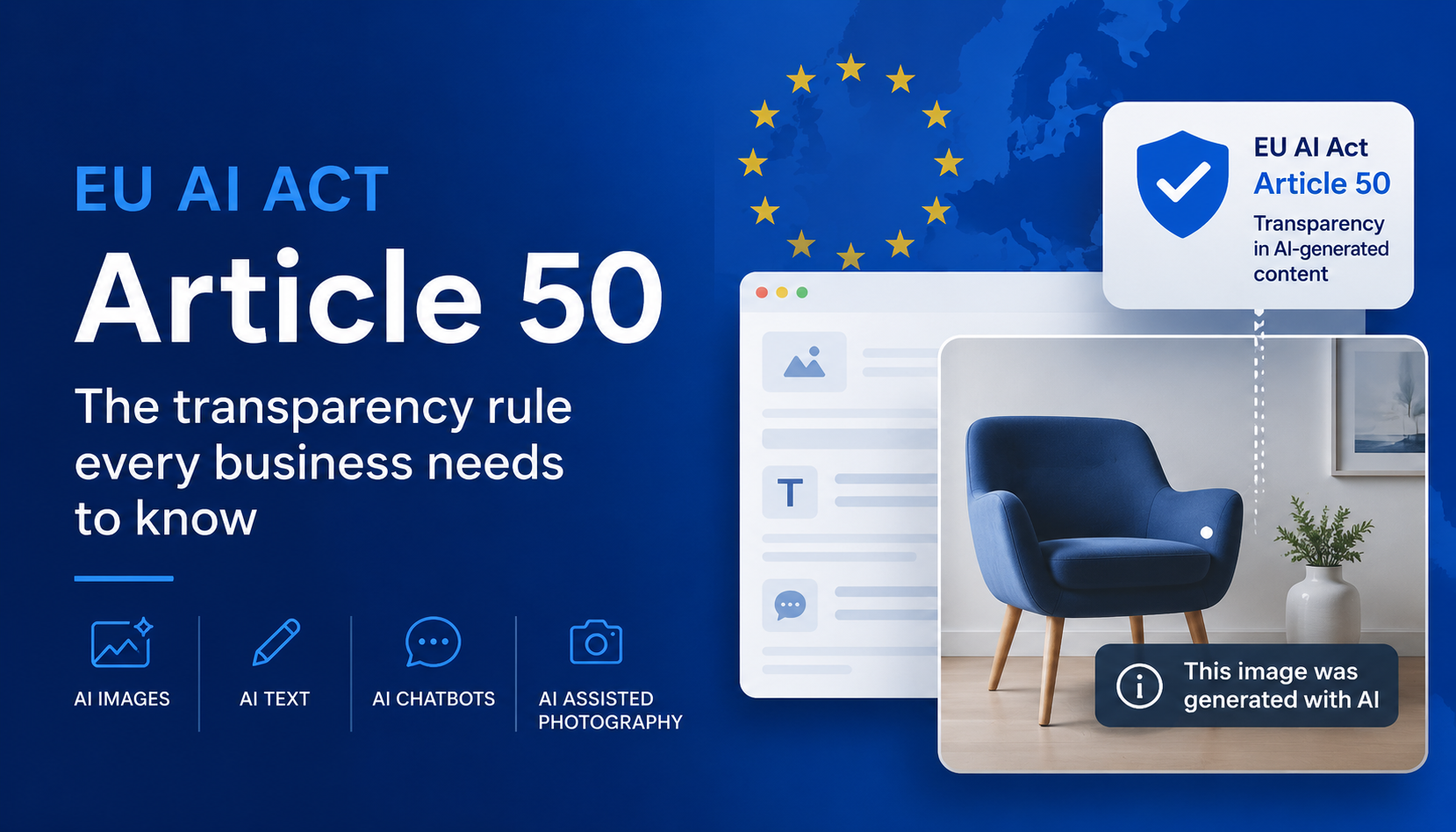
Article 50 is the transparency part of the EU AI Act. It matters not only to AI developers, but also to organisations that use AI-generated or AI-manipulated content in day-to-day business activity. If your business uses AI images, AI-assisted product photography, AI text, or AI chatbots, Article 50 may be relevant even if you did not build the underlying model.
Why Article 50 matters
Article 50 is just one part of the wider EU AI Act, the world's first comprehensive legal framework for regulating artificial intelligence. While much of the Act focuses on how AI systems are developed, assessed, and placed on the market, Article 50 has a more specific purpose: ensuring transparency when people interact with AI or consume AI-generated content.
This distinction is important.
Many businesses assume the EU AI Act only applies to companies building large AI models or developing sophisticated AI software. In reality, Article 50 often affects organisations that simply use AI as part of their everyday operations.
If your marketing team creates AI-generated images, your customer service team deploys an AI chatbot, or your ecommerce business uses AI-enhanced product photography, Article 50 may become relevant even if you did not build the underlying AI technology.
That is why Article 50 has attracted so much attention. It extends beyond AI developers and into thousands of organisations using AI as a practical business tool.
How Article 50 fits within the EU AI Act
The EU AI Act contains numerous chapters covering different aspects of AI regulation, including:
- rules for prohibited AI practices
- obligations for high-risk AI systems
- requirements for general-purpose AI models
- governance and enforcement
- market surveillance
- transparency obligations under Article 50
Unlike many other parts of the legislation, Article 50 is not based on the level of risk posed by an AI system.
Instead, it focuses on one simple principle:
This makes Article 50 one of the most widely applicable sections of the legislation.
For a broader plain-English overview of the rule itself, see What is the AI Transparency Act?.
The four questions every organisation should ask
Before worrying about compliance, every organisation should answer four simple questions.
1. Are we using AI?
This sounds obvious, but many organisations underestimate how much AI they already use.
Examples include:
- AI-generated marketing images
- AI-written website copy
- AI-assisted product photography
- AI-generated videos
- AI voiceovers
- customer service chatbots
- AI image enhancement tools
- AI-powered search assistants
If AI plays any role in creating or presenting content, it is worth considering whether Article 50 applies.
2. What is our role?
Your obligations depend heavily on how you interact with the AI system.
For example, are you:
- building an AI model?
- integrating AI into your own software?
- deploying AI internally?
- publishing AI-generated content?
- distributing another company's AI system?
The EU AI Act distinguishes between providers, deployers, importers, and distributors, each with different responsibilities.
For practical scope questions, start with Does my business need to make AI disclosures? and What is the AI Transparency Act?.
3. Does our use of AI fall within Article 50?
Not every use of AI creates a transparency obligation.
For example, some AI-generated content requires disclosure, while other uses may fall outside Article 50 altogether or benefit from specific exemptions.
Understanding this distinction is one of the most challenging aspects of compliance. If you need a practical decision point, Does my business need to make AI disclosures? is the best next read.
4. If disclosure is required, how should we implement it?
Even when disclosure is necessary, organisations still need to determine:
- what wording should be used
- where the disclosure should appear
- whether labels should be visible to everyone or only relevant users
- how disclosures should be maintained over time as new content is published
Practical implementation is often where organisations spend the most time.
For implementation detail, see What do disclosure labels look like?, AI Transparency, and Install TickAI.
The Article 50 journey
Rather than thinking of Article 50 as a legal document, it helps to think of it as a practical workflow.
Use AI
  ->
Identify where AI has been used
  ->
Determine your role
  ->
Assess whether Article 50 applies
  ->
Check for any exemptions
  ->
Apply appropriate disclosures
  ->
Monitor future AI content
  ->
Maintain records and governance
This guide follows that same journey, taking you from understanding the legislation through to practical implementation.
How this knowledge base is organised
Because Article 50 covers a wide range of topics, we have organised our resources into six specialist sections. You can work through them in order or jump directly to the area most relevant to your organisation.
Fundamentals
Understand the legislation, key terminology, and the roles defined within the EU AI Act.
Transparency requirements
Learn when Article 50 requires disclosure, which AI systems are covered, and what organisations must communicate to users.
Practical compliance
Follow step-by-step guidance for implementing disclosures, reviewing AI-generated assets, and maintaining a repeatable process.
Exceptions and edge cases
Explore the grey areas, including AI-enhanced photography, editorial review, obvious AI content, and other common questions.
Official guidance
Access the legislation, supporting guidance, and implementation principles in one place.
Updates
Stay informed about future Article 50 developments, enforcement questions, and new practical guidance as more content is published.
Next: the fundamentals
Now that you understand where Article 50 sits within the wider EU AI Act, the next step is to explore the fundamentals.
Start with What is the AI Transparency Act?, then move to Does my business need to make AI disclosures?. Together, those guides explain what the rule is, who it reaches, and how to start applying it in practice.
FAQ
What is Article 50 of the EU AI Act?
Does Article 50 only apply to AI developers?
If we use third-party AI tools, can Article 50 still apply to us?
Does every AI-touched asset need a disclosure?
What should a business do first if it thinks Article 50 may apply?
Further reading
See where your site stands
Run a free scan to find AI-generated images, video, and text on your site that may need an Article 50 disclosure.
Run a free scanThis article is general information, not legal advice.